Sun Belt Oversupply: Austin, Dallas & Phoenix Are a Buyer's Market
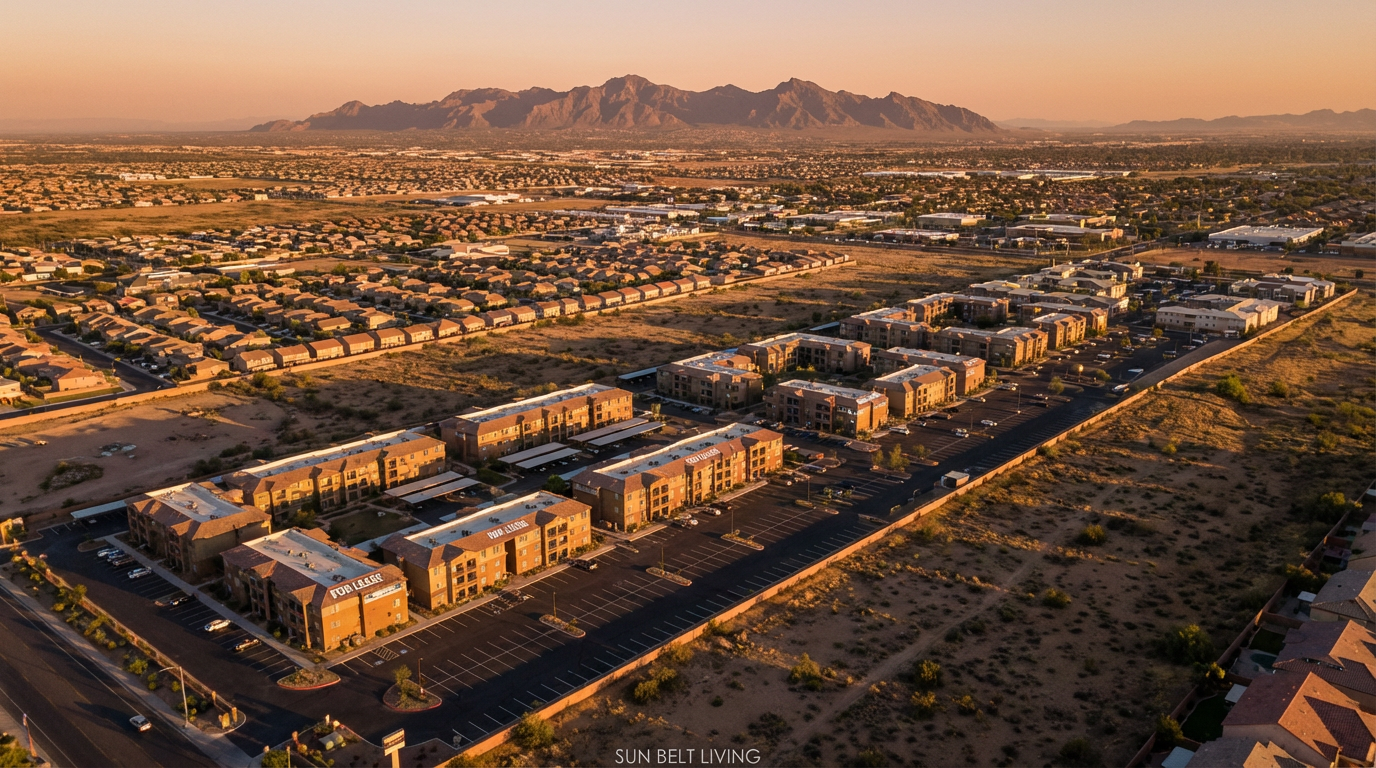
Sun Belt Oversupply: Austin, Dallas & Phoenix Are a Buyer's Market
For years, the Sun Belt was the darling of real estate investors. Population booming, rents skyrocketing, permits flying off the desk at city hall. Everyone wanted in. Developers couldn't build fast enough.
Turns out, they built too fast.
Now the hangover is here. Austin's apartment vacancy rate has ballooned to 13.8%. Rents are down 7.3% year-over-year. Dallas and Phoenix aren't far behind. Multifamily starts across the Sun Belt dropped more than 40% between 2023 and 2025, but the damage was already done — tens of thousands of units that broke ground during the frenzy are now hitting a market that can't absorb them.
Landlords who bought at the peak with floating-rate debt and pro formas built on 2022 rent assumptions? They're underwater. And many of them are about to become very motivated sellers.
If you know where to look, this is one of the best buying opportunities in the Sun Belt in a decade.
The Sun Belt Building Boom Just Hit a Wall: What the Data Shows
Let's rewind. Between 2021 and 2023, Sun Belt metros experienced a construction surge unlike anything in recent memory. Austin alone permitted more apartments per capita than almost any major metro in the country. Phoenix and Dallas weren't far behind. Developers were chasing the same thesis: remote workers fleeing California and the Northeast, strong job growth, landlord-friendly regulations, no state income tax.
The thesis wasn't wrong. But the timing was brutal.
Here's what happened: interest rates went from near-zero to over 7% in the span of 18 months. Construction costs spiked. And all those units that started in 2022 and 2023 began delivering into a market where demand growth had slowed and affordability was already stretched.
According to PwC's 2026 multifamily outlook, multifamily starts dropped by more than 40% between 2023 and 2025 — but that pullback came too late. The pipeline was already full. The supply wave was already cresting.
The result? A classic oversupply correction, concentrated in the exact metros that everyone was piling into just three years ago.
Austin, Dallas & Phoenix by the Numbers: Vacancy, Rent Declines & Distress Signals
Let's get specific, because the numbers tell the story better than any narrative.
Austin:
- Apartment vacancy rate: 13.8% (up dramatically from the sub-5% levels seen in 2021)
- Rents down 7.3% year-over-year as of early 2026
- Some newer Class A properties are seeing effective rent declines closer to 20% when you factor in concessions like two or three months free
- Despite the drops, average rents are still roughly 10% above 2019 levels — meaning this is a correction of the 2021-2022 spike, not a collapse below fundamentals
Dallas:
- Vacancy rates have climbed above historical averages across multiple submarkets
- Rent growth has gone negative in several zip codes, particularly in areas with heavy new construction (Frisco, McKinney, parts of downtown)
- Concession packages are widespread — free months, reduced deposits, waived fees
Phoenix:
- Similar pattern: a flood of new supply meeting slower absorption
- Rent declines concentrated in the East Valley and Chandler/Gilbert corridors where new build-to-rent communities have saturated the market
- Occupancy dropping in properties that were underwritten at 95%+ stabilization
The distress signals are everywhere if you know what to look for: properties sitting on market longer, price reductions on Realtor.com and CoStar, and a growing number of multifamily loan workouts showing up in OCC supervisory data.
Why Peak-Era Landlords Are Underwater Right Now
This is where it gets interesting for investors looking for deals.
Think about the typical investor who bought a rental property — whether a single-family rental, a small multifamily, or a syndicated apartment deal — in Austin, Dallas, or Phoenix between late 2021 and early 2023. Here's what their deal probably looked like:
- Purchase price: At or near the market peak, often in a competitive bidding situation
- Financing: A mortgage at 5.5% to 7%+, or worse, a floating-rate bridge loan that's now resetting even higher
- Pro forma rents: Based on the assumption that 2021-2022 rent growth would continue, or at minimum hold steady
- Vacancy assumption: 5% or less
Now look at reality in early 2026:
- Actual rents: Down 7-20% from those pro forma projections
- Actual vacancy: Double or triple what was underwritten
- Debt service: The same or higher, because rates haven't come down meaningfully
- Operating costs: Insurance, property taxes, and maintenance have all increased
The math simply doesn't work anymore. Monthly cash flow has gone from positive to deeply negative. These landlords aren't making money — they're writing checks every month to keep the property afloat.
And here's the kicker: many of them can't refinance. Their properties don't appraise at the original purchase price anymore, and lenders aren't eager to take on Sun Belt multifamily exposure right now. They're stuck.
Some can hold on. But plenty can't. Especially solo landlords or small operators without deep reserves. They're the ones you want to find.
The Distressed Seller Formula: Vacancy + High Mortgage + Falling Rents = Motivation
Not every landlord in Austin, Dallas, or Phoenix is distressed. You need to identify the ones who are actually feeling the squeeze. That means stacking multiple pressure points:
1. High vacancy or extended days on market for rentals
A property that's been listed for rent for 60+ days — or one that's clearly sitting empty — is burning cash. Every month vacant is a month of mortgage, taxes, insurance, and maintenance with zero income.
2. Recent purchase at peak pricing (2021-2023 vintage)
Someone who bought in 2018 at a lower basis and locked in a 3.5% rate? They're fine. But someone who bought in mid-2022 at the top with a 6.5% mortgage is in a completely different position. Acquisition date matters enormously.
3. Likely high-rate or adjustable-rate mortgage
Bridge loans, adjustable-rate mortgages, and interest-only periods that are expiring create forced-action timelines. When the payment jumps, the owner has to make a decision.
4. Rent declines in the specific submarket
Not all neighborhoods within Austin or Phoenix are equally affected. The pain is concentrated where new supply is heaviest. Focus on zip codes with the most new deliveries.
5. Out-of-state ownership
Investors who bought Sun Belt rentals from California or New York during the pandemic boom and have never set foot on the property? They're often the first to want out when the numbers turn negative. Distance creates frustration.
When you find a property that checks three or more of these boxes, you're looking at a genuinely motivated seller — someone who may take a below-market offer just to stop the bleeding.
How to Find Distressed Sun Belt Landlords Before They List
This is where most investors get it wrong. They wait for properties to show up on the MLS or on Zillow with a price reduction. By then, the opportunity has been picked over. The real money is in finding these sellers before they list.
Here's a practical playbook:
Drive for Dollars (Yes, Even in Sun Belt Markets)
Physically driving neighborhoods — or using DealDriven's driving for dollars feature — to spot signs of distress: overgrown yards on rental properties, multiple units in a complex with vacancy signs, properties that look neglected. In markets like Austin's East Riverside corridor or Phoenix's West Valley, the visual cues are everywhere right now.
Skip Trace Absentee Owners
Pull lists of absentee owners in high-vacancy zip codes. These are people who own property in Austin, Dallas, or Phoenix but live somewhere else. Use skip tracing to get their phone numbers and mailing addresses. An out-of-state owner with a vacant rental property in a declining rent market is the profile you're looking for.
Stack Data Filters
- Acquisition date: 2021-2023
- Owner address different from property address (absentee)
- Property type: single-family rental or small multifamily (2-4 units)
- Located in zip codes with highest new apartment deliveries
- Listed for rent on Zillow/Apartments.com for 45+ days, or previously listed and removed (failed to rent)
This kind of list building is exactly what DealDriven is designed for. Stack these filters, build your list, and you've got a targeted set of likely-motivated sellers.
Direct Mail with the Right Message
Generic "We Buy Houses" postcards won't cut it here. These are investors, not distressed homeowners. They speak a different language. Your message should acknowledge what they're going through:
"Owning a rental in Austin right now isn't easy. If vacancy and falling rents have turned your investment into a monthly expense, I'd like to make you a fair cash offer — no commissions, no repairs, close on your timeline."
Speak to their pain. Be specific. Be direct.
Cold Calling and Texting
Once you've skip traced your list, follow up with calls or texts. Again, tailor the conversation. Ask about their vacancy situation. Ask how long the property has been without a tenant. Most won't be ready to sell on the first call, but you're planting a seed. When month six of negative cash flow hits, you want to be the person they remember.
Watch for Pre-Foreclosure and Loan Default Signals
As we move through 2026, expect to see more notices of default, particularly on properties with bridge loans or maturing debt. Public records and county filings are your friend. Fitzgerald Advisors has noted a growing volume of Sun Belt multifamily debt sales and workouts — this trend is filtering down to smaller properties too.
Timing the Sun Belt Recovery: When Oversupply Becomes Opportunity
Here's the thing about supply corrections: they're temporary. And the same fundamentals that drove the Sun Belt boom — population growth, job creation, affordability relative to coastal markets, business-friendly policies — haven't disappeared. They're just temporarily overshadowed by a supply glut.
Multifamily starts have already cratered. Developers have pulled back hard. The pipeline of new units delivering in 2027 and 2028 is significantly smaller than what we've seen in 2024-2026. That means absorption will eventually catch up. Vacancy will tighten. And rents will stabilize, then start climbing again.
The investors who buy distressed Sun Belt assets in 2026 at a discount — with realistic underwriting, not peak-era fantasies — are going to look very smart in 2028 and 2029 when the market rebalances.
But you have to be smart about it:
- Underwrite conservatively. Use today's rents, not projections. Assume vacancy stays elevated for 12-18 months.
- Buy at a real discount. If the math doesn't work at current rents and current rates, the deal isn't good enough. Don't bet on rate cuts or rent recovery to make your numbers.
- Secure fixed-rate financing if at all possible. The last cycle's biggest casualties were investors on floating-rate debt.
- Focus on locations within these metros that have the strongest long-term demand drivers — proximity to major employers, good school districts, limited future land for development.
The Sun Belt isn't broken. It overbuilt. There's a massive difference. And for investors with the right tools and the discipline to find motivated sellers before they hit the open market, the next 12 to 18 months could be a generational buying window.
Stop waiting for deals to come to you. The distressed Sun Belt landlords are out there right now, losing money every month, trying to figure out their exit. Be the exit.